

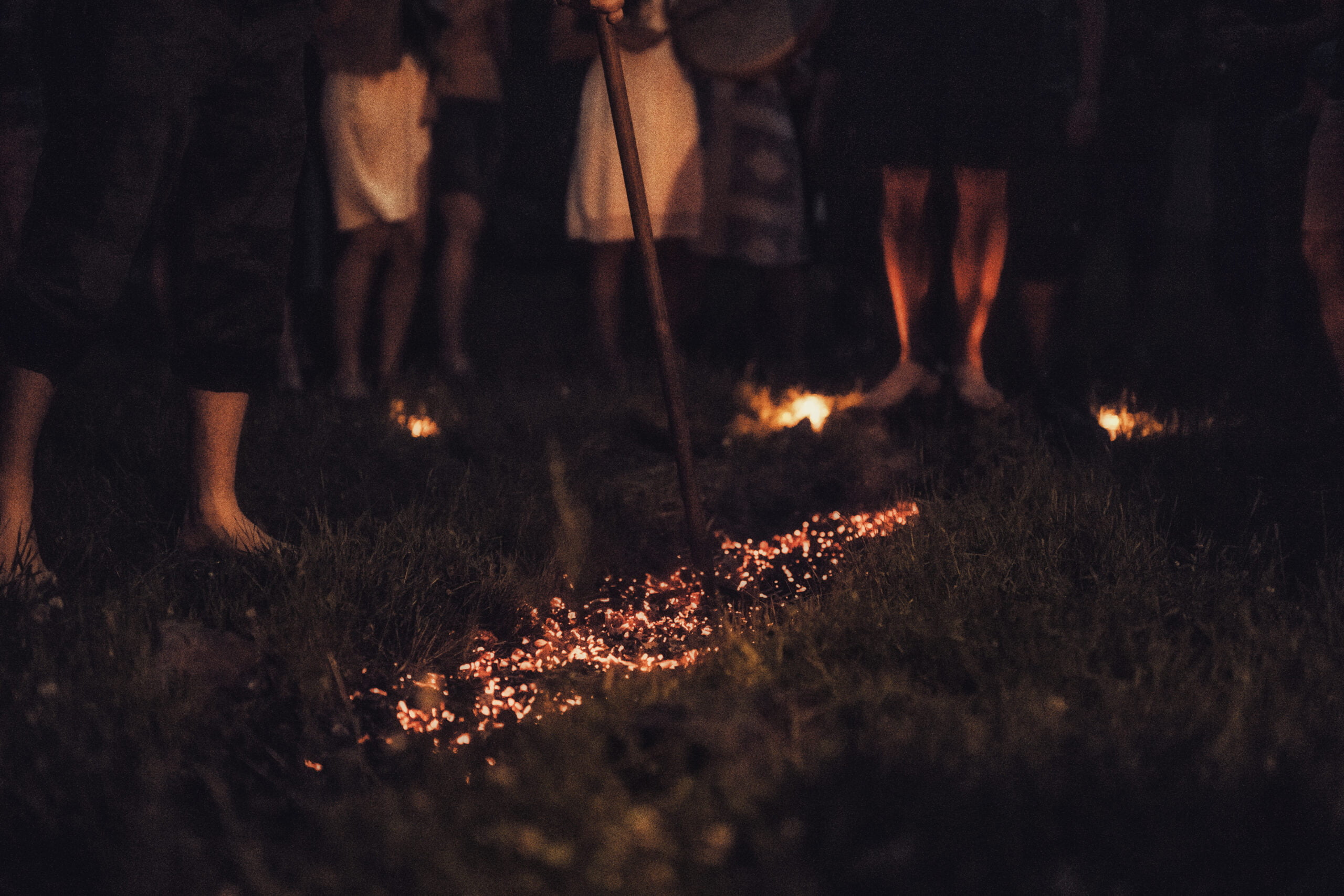
I think that there is no need to explain the very definition of rites of passage. They have already been mentioned a lot in other writings, but let’s try to use our own working definition to avoid ambiguity. In short, we can say that it is a fairly predictable pattern of repetitive activities in the scope of a specific community; entering into new social roles or subordinating oneself to certain cultural, social or religious themes, historically and geographically conditioned, taking into account the magical element that conjures up reality (e.g. prayers for intentions, burning Marzanna) in order to increase the experience of safety and the scope of influence, which occurs in a more or less ritualized ritual taking place surrounded by witnesses or without their participation.
I mentioned magical threads here, i.e. a certain way of thinking based on the conviction: I will do something so that it will be good. Such action does not have to have the consent or participation of other people. It was also not always supposed to be conducive to the environment, which is why these magical threads are very interesting from the perspective of anthropological research. Burning at the stake did not come out of nowhere, although it claimed many innocent victims. However, let’s stay for the needs of the blog when thinking about magic in a more practical and positive way.
Another element that appeared as part of the creation of a working definition of what rites of passage are was the ritual thread, the purpose of which is to provide a sense of predictability, cyclicality, repetition, awareness of what is happening and what the order should be so that it can be imitated together. At the level of relationships, he could “cement” (unify, reconcile, strengthen in the experience of community and the purposefulness of being in it) a social group such as families, neighbors, guests. Until recently (even a few decades ago), such communities were actually doomed to each other, so that the survival of the individuals that make up them would be possible at all.
What kind of rite are we talking about?
We are talking about autumn, which slowly prepares us for the shortest day of the year and for a longer period of cold and lack of abundance in food choices, it also forces us to save and encourages us to stay at home.
Supposedly shorter days, darkness in our times are not so scary, but it is not always a real experience on the level of emotions. I can’t say at the moment whether we collectively sense that the world is now predictable. Probably to some extent, yes. On the other hand, too many changes have taken place in a fairly short time and too close (pandemic, lockdowns, work-related difficulties for many people, surprising changes in legislation, an absolute ban on abortion, strikes, war right next to the border, military conscriptions, the risk of total war, new drugs, a lifestyle built on group drug use, changes in cultural norms and patterns for young people) to adopt a rather optimistic perspective from a few years ago.
I wonder to what extent we need ritual or dealing with relationships at the ritual level. Trying to move behind a freely emerging thought, I would replace the word ritual with a routine that I am very supportive of in the lives of my patients as a psychologist. I do this because, in my opinion, routine can help plan a day, a week, certain seasons. It allows for predictability and, as far as possible, the implementation of your plans. This, in turn, has a positive effect on the sense of agency and security. It can become the basis of a good life, because it anticipates various events well in advance and helps to create a certain order. We can also change it, adapting to our needs what is realistically possible.
In our cultural circle, in the autumn we usually celebrate All Saints’ Day in quite crowds, including Forefathers’ Eve (already “zesternized” to some extent Halloween as part of ghost repelling) and All Souls’ Day. The Slavic Forefathers’ Eve itself was also supposedly celebrated in the spring, and the beliefs associated with it concerned the Journey of Souls.
Is it an important topic psychologically? A little bit like that, hence this post.
From my point of view, a certain order is important, which we observe as much as we can. This direction of encounter with some spiritual element, socially acceptable, also religious and cultural, with something abstract and at the same time as concrete as death is extremely important. This is how I would understand All Saints and our Slavic-Catholic attitude towards the Dead.
The dead have a certain place in our culture, also on an individual level.
Mourning is also defined, it has a framework.
Grief and despair, on the other hand, go beyond them and we actually work on them during psychotherapy, saying that we cannot cope with grief.
Returning to various legends, in this autumn period (it turns out that also in spring, but I will not elaborate on this here due to the lack of data) the souls of the dead wandered around the world, cold and looking for food. They wanted to return to the home they remembered and treated as their own. I have not found an answer as to why they wandered, although it is very interesting where such beliefs come from. However, it seems that the cemetery and the memory of the dead is a very reasonable solution for Catholics. The French comedy Guests Guests comes to mind, as a joke I use this example that it is not always worth leaving your own home open for guests.
With the development of knowledge, cities, young people’s work trips, changes in lifestyle, family relationships or relationships related to a given community naturally relaxed, modifying a little the individual attitude to death and the need for direct contact with it during this period of the year.
Nowadays, we tend to remember about loved ones who have passed away, we return to their photos, we remember about the burial or saying goodbye to them. Some people still experience death in the religious space.
I wanted to point out that from a psychological point of view, it is worth sticking to a certain routine, not thinking about the rituals themselves. No other magic than a positive attitude is needed. For example, thinking that I will do it so that it will be good seems absolutely sufficient.
Routine may turn out to be the most important thing in a world that is changing. It is also important to know what is behind a given routine and tradition, because this routine can also result from it in an absolutely rational and logical way.
Is there a place for fear here? It is possible that so, I myself wonder whether modern man would survive the religious and spiritual rites from 100 years ago, or even 50 years back in some random smaller village. Maybe we are too afraid of death, or maybe we should be afraid of it. Maybe it’s just worth remembering about the loved ones of the deceased and what we need to know in order to be able to move on and develop individually. Maybe knowledge and memory are enough for the rite of passage to take place alone and naturally.
Or maybe you should stick to a ritual expressed both individually and on a social level, because such an event will be binding?
The most important thing is that there is a choice and actually everyone can be the right one if they are also responsible.
Best regards,
Paulina Kubś, MSc, Interventional Systemic and Cultural Psychotherapy Clinic
I also invite you to follow my FB pages that are starting to develop positively, such as the Cabinet itself; Paulina Kubś Cabinet of Interventional Systemic and Cultural Psychotherapy, but also Mind and YogaArt and Sacred Feminity, or Arte per Soma. They will be richer and richer with appropriate structures, suggestions for classes, and entries. You can find this one on Sacred Feminity and more.
Also, don’t be afraid of Sacred Feminity, for now it shows the extreme of female heterosexual feminism. It will continue to be conducted based on knowledge, the background will also be rich in metaphors, but it will be about positive female spirituality and feminism (closer to the 3rd wave).