

Dear Ladies and Gentlemen,
People who start psychotherapy sometimes start their first conversation not with a description of the problem itself, but with doubts about whether their difficulties are serious enough:
“Actually, I don’t know if I should be here.”
“I’m taking time away from someone who definitely needs it more.”
“Others have real dramas, and I just can’t cope somehow.”

You may also know the moment when you are thinking about making an appointment, but almost immediately the thought arises: “Maybe I’m exaggerating?”. We begin to compare our own difficulties with other people’s stories and come to the conclusion that if someone is worse off, then our suffering is not a sufficient reason to seek support.
Why do we so easily belittle our own difficulties? Let’s take a look at a few possible sources of this way of thinking – family experiences, cultural messages, and ways of responding to stress.
The first trap: “Others have it worse” and the culture of invalidation
In some families and environments, one can come across messages in which showing difficult emotions or talking about one’s own suffering is sometimes treated as a weakness. Many of us have heard the following messages in our childhood:
- “Don’t cry, nothing happened.”
- “People in war have it worse.”
- “You have something to eat, you have a roof over your head, your health is good – what do you mean?”
Repeated messages of this kind can foster the belief that one’s own emotions are justified only when something extremely serious happens.
As a result, gratitude, which can be a valuable experience in itself, sometimes begins to be used to invalidate one’s own difficulties. We convince ourselves that if others have experienced something more serious, then our panic attacks, feelings of emptiness, overload or crisis in the relationship are something that is “not appropriate” to deal with.
Difficult emotions can then be pushed into the background instead of being treated as information that something in our functioning needs attention.
Trap two: “Others have it better” and the feeling of being spoiled
The other side of the same coin is comparing yourself to people who seem to be doing great with life from the outside. We live in the age of social media and carefully created images. We see people who combine demanding work, parenting, physical activity and personal development with a smile.
What can appear in our head when we juxtapose this image with our own morning problem with getting out of bed?
- “If they can do it and I can’t, it means I’m just lazy.”
- “Everyone lives somehow, only I have a problem with ordinary everyday life. Something is wrong with me.”
Such comparisons can intensify shame and a sense of inadequacy. Shame, on the other hand, can make it difficult to talk about problems and ask for support, especially if it is accompanied by the belief: “I should be able to cope on my own”.
Your nervous system doesn’t know the rating scale
The severity of suffering cannot be assessed solely by comparing events.
People differ in previous experiences, current workload, health status, available support and ways of coping with stress. The same event can therefore be experienced by two people in very different ways.
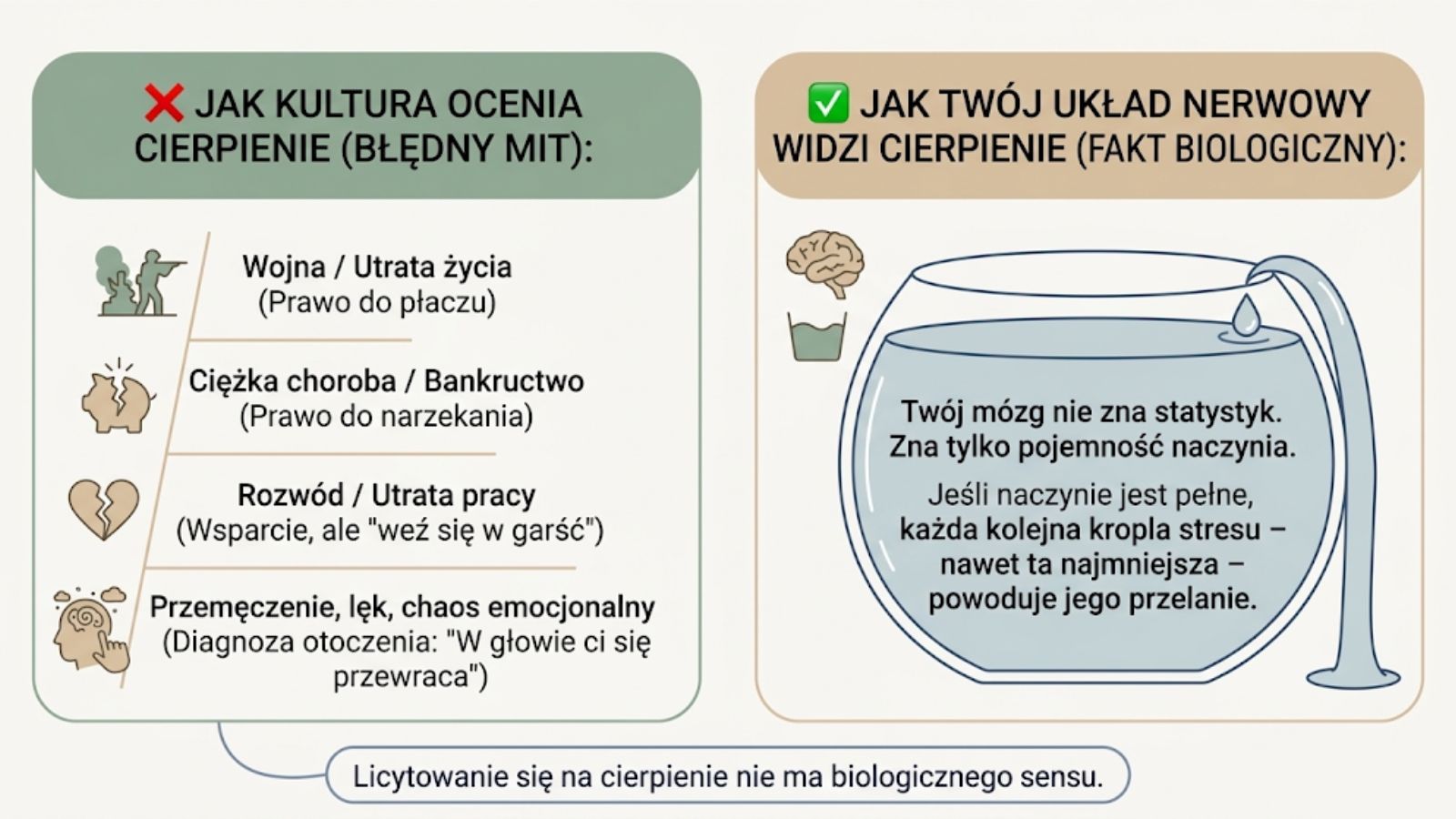
A critical remark from a supervisor may be a short-term, unpleasant experience for one person, and for another it may be associated with strong tension, anxiety or difficulty in regaining balance. This reaction can be influenced by many factors and does not automatically mean that someone is “weaker” or “exaggerating”.
Subjective suffering is real, even if someone else in a similar situation reacts differently.
At the same time, this does not mean that every strong emotion indicates a mental disorder or requires psychotherapy. Among other things, the severity of symptoms, their duration, impact on daily functioning and the individual situation of a given person are important.
When is a problem “important enough”?
Many people wonder where the limit lies, after which it is “appropriate” to see a specialist.
There is no one universal limit or list of problems that are “serious enough.” However, there are a few signs that are worth taking a closer look at.
| Situation | What the inner critic can say | What to consider |
|---|---|---|
| Chronic fatigue and lack of joy | “Everyone is tired sometimes, pull yourself together.” | If fatigue, low mood or loss of interest in what used to be enjoyable persist and affect daily functioning, it is worth taking it seriously and considering a consultation. |
| Relationship difficulties, repeated quarrels | “Others have real dramas. We are just whining.” | Repeated conflicts, increasing distance or difficulty in communicating needs can be reason enough to take a closer look at the functioning of the relationship. |
| Feeling lost, chaos in the head | “You don’t know what you want because you’re analyzing too much.” | A long-term feeling of confusion, difficulty recognizing one’s own needs or making decisions can be a source of significant discomfort and it is worth looking into. |
| Constant stress and tension | “Everyone lives under stress.” | Long-term stress can affect your well-being and physical health, especially when it makes it difficult to sleep, rest, concentrate or function on a daily basis. |
You don’t have to wait for a diagnosis or an extreme crisis to consider talking to a specialist.
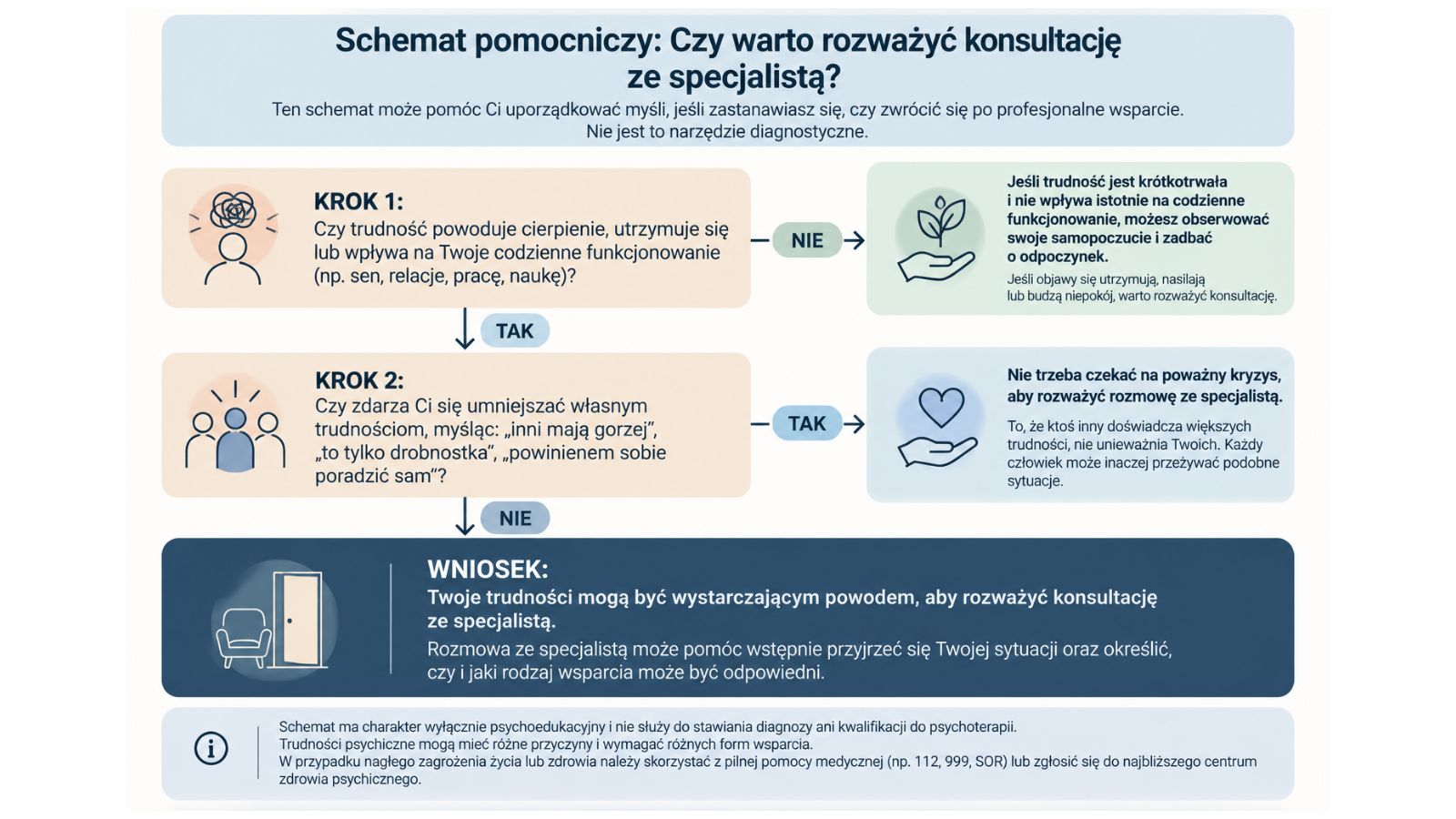
One important sign may be when difficulties cause suffering, recur regularly, or begin to affect relationships, work, sleep, responsibilities, or other important areas of life.
At the same time, not every problem requires psychotherapy. Sometimes the support of loved ones, rest, a change in life situation or psychoeducation may be sufficient. In other situations, psychological, psychotherapeutic, psychiatric or medical consultation may be appropriate.
You don’t take away anyone’s space
Suffering cannot be meaningfully compared only by asking whether someone else has experienced something more difficult.
Job loss, difficulties in setting boundaries, relational crisis, overload or traumatic experiences are different problems that can have different meanings for different people and require different types of support.
The fact that one person is experiencing a more serious crisis does not mean that another person’s difficulties cease to matter.
It is also not necessary to be in an extreme crisis to consider a psychological or psychotherapeutic consultation. However, the type of support should correspond to the nature and severity of the difficulties of a particular person.
Seeking help does not require waiting for the problem to reach a certain level of severity. A consultation can be used to take an initial look at the situation and consider what kind of support – if at all – would be appropriate in a given case.
If it is difficult to assess the significance of your own symptoms or difficulties on your own, you may consider consulting a specialist. The consultation itself does not prejudge the need to start psychotherapy. It can be an opportunity to put the situation in order and determine whether further support is needed and what form of support it may be adequate.
Information: The article is psychoeducational in nature and is not intended to make a diagnosis or determine whether a particular person requires psychotherapy. Mental health difficulties can have different causes and require different forms of support. In the case of intensified, persistent symptoms or a significant deterioration in daily functioning, it is worth consulting an appropriate specialist.