



Dear Ladies and Gentlemen,
It usually starts with a small thing. Unthrown garbage, a forgotten anniversary, tone of voice at breakfast, too long work in front of the computer. One sentence thrown in a hurry becomes a spark that sets in motion a well-known scenario. Before you can take a breath, the conversation turns into a row. Arguments turn into accusations, the words “you always” and “you never” are mentioned. Eventually, one of the partners leaves, slamming the door, and the other closes in silence, feeling lonely and regretful.
When emotions subside, exhaustion sets in. And this boomerang recurring question: Why did we do it again? Why have we been arguing about the same proverbial dirty cup in the sink for years?
When couples in crisis come to therapy, they sometimes come with the hope that the therapist will decide who is right and who is responsible for the problem. However, couples therapy usually does not involve acting as a judge. One of its possible goals is to better understand each other’s reactions and patterns that can sustain conflict.
However, this does not mean that responsibility for specific behaviors ceases to matter. Violence, threats, coercion, intimidation or controlling behaviour require a separate assessment and should not be presented as a “common problem” of both parties.
The iceberg rule: sometimes a cup in the sink is not just a cup
In the systemic approach, attention is drawn to the fact that the conflict over everyday duties or the way of spending time can have more than one level. What you see on the surface can be a specific problem in itself, but it can also trigger deeper emotional meanings.
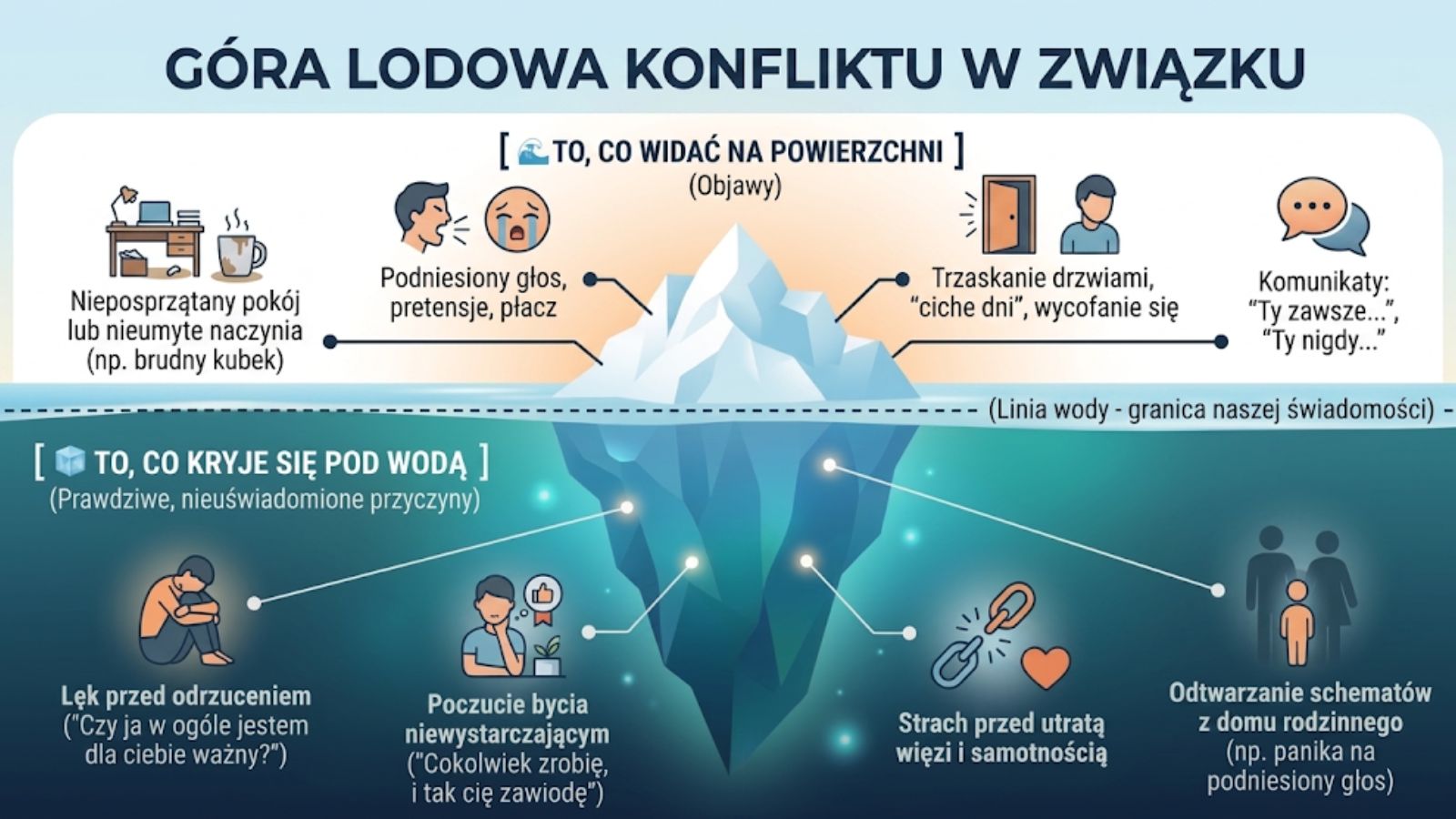
Unwashed dishes can therefore simply be a source of frustration related to the unequal division of duties. At the same time, they can trigger thoughts such as: “My job doesn’t matter”, “I’m alone with all this”, “I can’t count on a partner”.
On the other hand, a critical tone may be perceived by the other person as a signal of disappointment, rejection or being insufficient. In such a situation, there may be a need to withdraw from the conversation, limit contact or end the conflict.
This does not mean that every argument hides trauma or deep fear. Rather, the current conflict can sometimes trigger previous experiences, beliefs, and vulnerabilities of both partners.
In this way, a vicious circle of mutual reactions can be created, which in some therapeutic approaches is metaphorically described as “relational dance”.
A dance that can hurt both parties
In many couples, you can notice repetitive ways of responding to tension. One of the frequently described patterns is the dynamics of pursuit and retreat.
- Person requesting contact: In a situation of tension or a sense of distance, he may intensively try to restore contact. Sometimes he does it through criticism, pressure, raised voice or frequent questions. Such behavior may be due to, among other things, the fear of losing closeness, a sense of loneliness or the need to get an answer.
- Withdrawing person: In the same situation, they may feel overwhelmed, pressured, or afraid of conflict. The reaction may be silence, leaving the room, running away to work or limiting emotional contact. For some people, this may be associated with the fear of criticism or the feeling that whatever they do will be insufficient.
The more one person pushes, the stronger the need for the other to back off can be. The more the second withdraws, the more anxiety the first may feel.
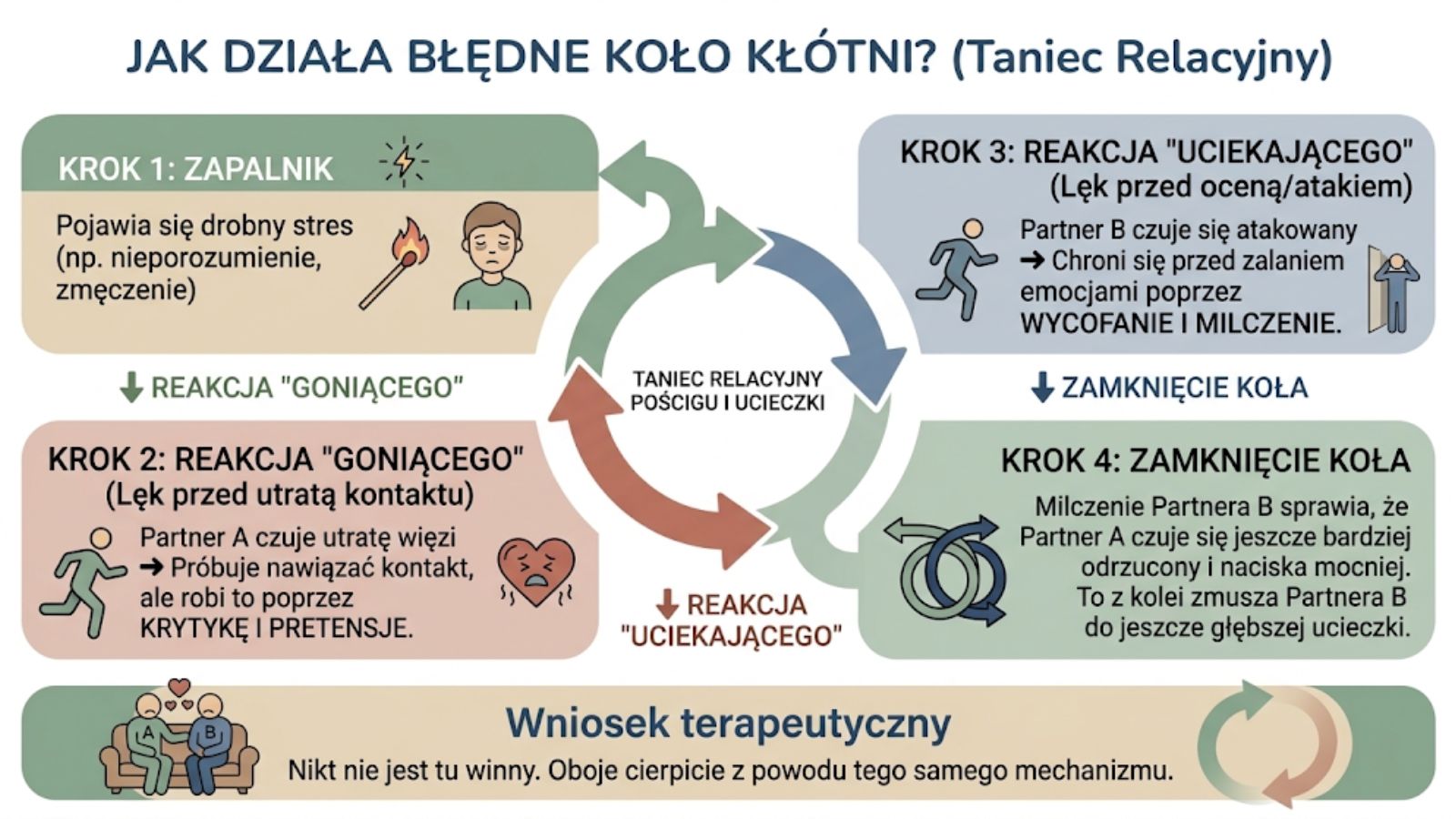
In many conflicts, it may be more useful than pointing to one person as the source of the whole problem to look at how the partners’ mutual reactions sustain a certain pattern.
However, this does not mean that “only the scheme is to blame”. Each person is still responsible for their own behavior, words and the way they treat their partner.
Suitcases from the past, or the clash of two systems
Why do we react in this way?
When we enter into a relationship, we are not a clean slate. Both partners bring their own family experiences, previous relationships, beliefs and ways of dealing with conflict to the relationship.
It can be said that each partner brings their own “suitcase” with them.
- If conflicts in the family home often involved yelling, the partner’s raised voice may later cause stronger tension, the need to withdraw or a counterattack.
- If someone experienced prolonged silence as a form of punishment or rejection in childhood, withdrawing a partner during conflict can be especially difficult and trigger the fear of losing the bond.
- Cultural scripts can also be important. Some men may grow up with the message that you should suppress your emotions, deal with it on your own, and focus on solving the problem. Some women, on the other hand, may face a stronger expectation to take care of relationships, other people’s emotions and maintain closeness. However, these are not universal rules and similar patterns can occur regardless of gender.
We can unconsciously repeat some fixed ways of reacting, even if we consciously want to behave differently.
Therapy is not a courtroom – an attempt to understand each other’s reactions
Couples therapy doesn’t have to be about deciding who won a particular argument. One of the possible areas of work is to look at what happens between partners in the subsequent stages of the conflict.
You can analyze such a sequence step by step: what triggered the tension, how the other person’s behavior was interpreted, what emotions appeared and what happened later.
One of the directions of work can also be recognizing emotions and needs that are hidden under criticism, withdrawal or silence.
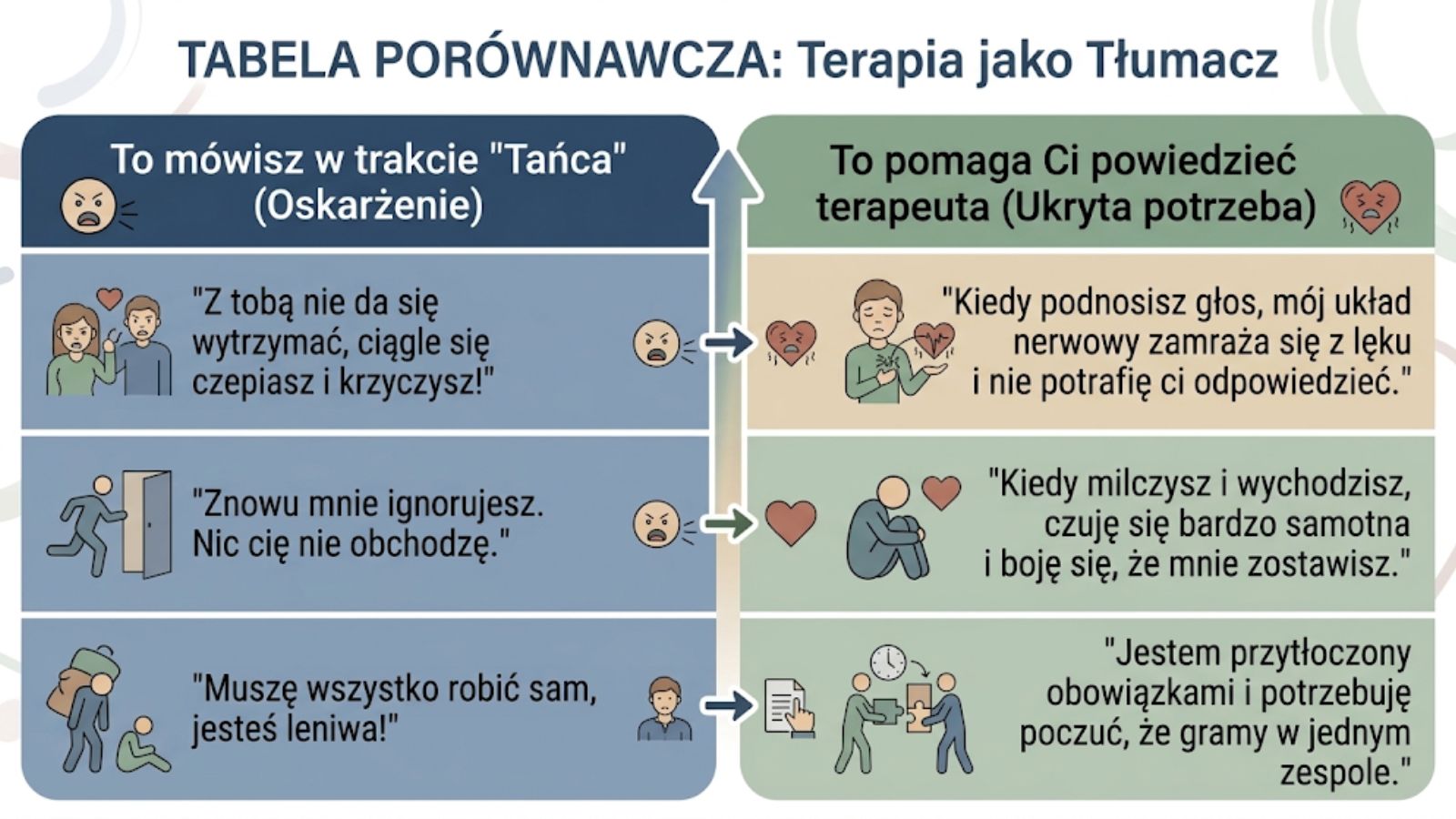
For example, instead of:
“You ignore me again, you don’t care”
You can try to describe your own experience:
“When you leave the room in the middle of a conversation, I feel lonely and I start to worry that this conversation is not important to you.”
Instead of:
“You can’t stand it, you’re still clinging”
You can try:
“When I hear a raised voice, I feel tense and find it difficult to continue talking calmly.”
Such messages do not guarantee a solution to the conflict. However, they can help express their own experience without automatically attributing intentions to the other person.
Regaining agency as a couple
A relationship crisis and recurring conflicts do not necessarily mean that feelings are extinguished or that the end of the relationship is a foregone conclusion.
They may indicate, among other things, that the current ways of dealing with tension do not bring the expected results. Sometimes the couple repeatedly tries to solve the problem in the same way, even though this way itself begins to sustain the conflict.
Couples psychotherapy may be one of the ways to look at such patterns. Depending on the situation, the work may include, but is not limited to, recognizing recurring conflict sequences, communicating emotions and needs, analyzing previous experiences, and looking at what each party can change in their own way of responding.
Not every couple needs the same type of work, and the effects of therapy may vary. The goal does not have to be to maintain the relationship at all costs. In some situations, it may be more important to better understand the relationship, the way of communication or make a more informed decision about its further shape.
If repeated conflicts lead to significant suffering, a sense of stuckness, or increasing distance, consulting a specialist may be one way to look at the situation from a broader perspective.
Important: The patterns described in this article are about relational conflicts and should not be used to explain violence, threats, coercion, intimidation, or controlling behavior. In such situations, the priority is the safety of the person experiencing abuse and an appropriate individual assessment of the situation.
Information: The article is psychoeducational in nature and is not intended to make a diagnosis or replace an individual consultation with a specialist. Conflicts in a relationship can have various causes, so it is worth considering their importance taking into account the situation of a particular couple.