


Dear Ladies and Gentlemen,
We live in a time when access to psychological knowledge has never been so common. We are surrounded by podcasts about building habits, guides on how to become the “best version of yourself”, meditation techniques, biohacking methods, affirmations and developmental challenges. At first glance, this is a wonderful phenomenon – as a society, we are becoming more and more aware of our emotions, boundaries and needs.
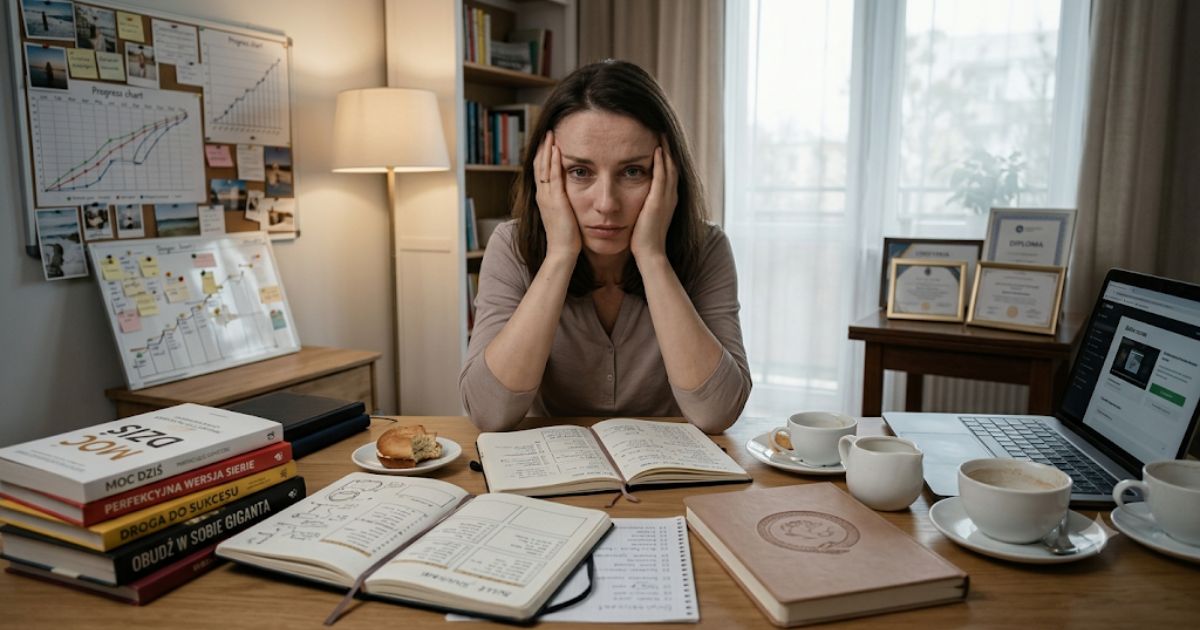
At the same time, you can also meet people who also experience less obvious consequences of constant pressure to work on themselves. They are sometimes exhausted and overstimulated by their own “healing” process. They spend every free moment analyzing their traumas, listening to developmental podcasts, and tracking their own mood, and yet they feel more and more fearful, tense, or emptiness.
When does working on oneself cease to be a path to greater freedom, and becomes an oppressive duty? When do we fall into the trap of continuous self-development, which – instead of supporting – begins to be another source of pressure, self-criticism and dissatisfaction with ourselves?
Culture of optimization and treating man as a project to be repaired
It is difficult to analyze the problems of an individual completely detached from the world in which he functions. Modern culture strongly emphasizes productivity, optimization, and continuous improvement, and a similar mindset is increasingly also encompassing the area of well-being and mental health. The message coming from the environment can be subtle, but demanding: “You can always be better. You can always get up earlier, manage your emotions better, eat healthier and work through your traumas faster.”

In this narrative, man ceases to be a living, sentient being who has the right to weakness, error and stagnation. It becomes a “design” to be optimized. We absorb this cultural script very deeply, starting to treat ourselves like a defective product on the assembly line. The belief that our worth depends on how much we are “overworked” in the therapeutic sense and how “aware” we are can lead to less and less contact with our own needs, emotions and limitations.
When Self-Improvement Becomes Another Way of Rejecting Yourself
One of the more difficult mechanisms may be a situation in which self-development becomes a camouflage for strong self-criticism and lack of self-acceptance.
Sometimes under the slogan “I want to work on myself” there may be a painful belief: “The way I am now, I am insufficient. Only when I fix all my flaws, work through my fears and be perfectly assertive – I deserve love, peace and respect”.
In such a mode, any behavior that does not correspond to the dream ideal – an outburst of anger, a day spent in bed because of sadness, reaching for unhealthy food – becomes a reason to whip oneself. We impose strict “emotional diets” on ourselves, forgetting that self-acceptance does not have to be a reward for perfect functioning. Excessive pressure on oneself does not have to manifest itself in screaming in front of the mirror. Sometimes it takes the form of mercilessly forcing ourselves to take another course, another meditation, another analysis of our behavior at the moment when we are already overloaded and need rest more than another task to perform.
Toxic positivity and the escape trap
In the discourse on self-development, the concept of toxic positivity also often appears. It is used to describe the pressure to maintain a positive attitude even when it leads to the diminishing, rejecting or suppressing difficult emotions.

The problem arises when the pursuit of a positive attitude leads to the invalidation of what we are actually experiencing. Sadness, grief, anger and frustration are natural reactions to loss, disappointment, overload or crossing boundaries. Forcing yourself to demonstrate positive emotions in a moment of crisis can lead to suppression of what you really feel. Difficult emotions don’t disappear just because we try to cover them up with affirmations or the imperative to think positively.
How to distinguish healthy work on oneself from oppression?
The line between self-care and excessive developmental pressure can be thin, but recognizing it can help you regain more balance.
| Development based on pressure and self-criticism | Supportive development | |
|---|---|---|
| Motivation | I act out of a sense of lack: “I have to fix this because I’m hopeless.” | I act out of respect for myself: “I want to take better care of myself and understand myself better.” |
| Response to the crisis | Self-criticism, shame, a sense of wasting the current therapy or working on oneself. | Validation of feelings: “I have the right to have a worse day. It does not cancel out the work so far.” |
| Pace | Fast, forced, goal-oriented. | Adapted to the current capabilities and load level, with space for breaks. |
| Attitude to disadvantages | An attempt to completely cut them out, suppress them and remove them. | Understanding your own limitations and working on them without rejecting yourself. |
Psychotherapy is not a repair like in a car repair shop
Psychotherapy does not aim to make a person a “superhuman”, resistant to all pain, never crying and always assertive. Therapy is not a workshop where a defective car is inserted and after a few months a flawless model is picked up.

One of the goals of psychotherapy may be to increase the space for a more conscious choice of how to react instead of constantly submitting to the pressure of change. It is also the right to be in the process. The right to stop sometimes and do absolutely nothing with yourself. The possibility of assuming that one’s own worth does not have to depend on whether one has already “fixed” every difficulty and worked through every problem.
If the pursuit of self-development has become a source of strong pressure, tension or constant dissatisfaction with yourself, it is worth looking at what drives the need for constant change. Talking to a specialist can be one of the ways to better understand these mechanisms. Sometimes the biggest change we can make is to stop trying to change ourselves by force.
Information: The article is psychoeducational in nature and is not intended to make a diagnosis or replace an individual consultation with a specialist. Difficulties related to self-criticism, overload or regulation of emotions can have various causes, so it is worth considering them taking into account the individual situation of a given person.